I study how political ideas and institutions shape who we become, what we value, and what makes life meaningful. My current book project on this topic is:
The Good Life State
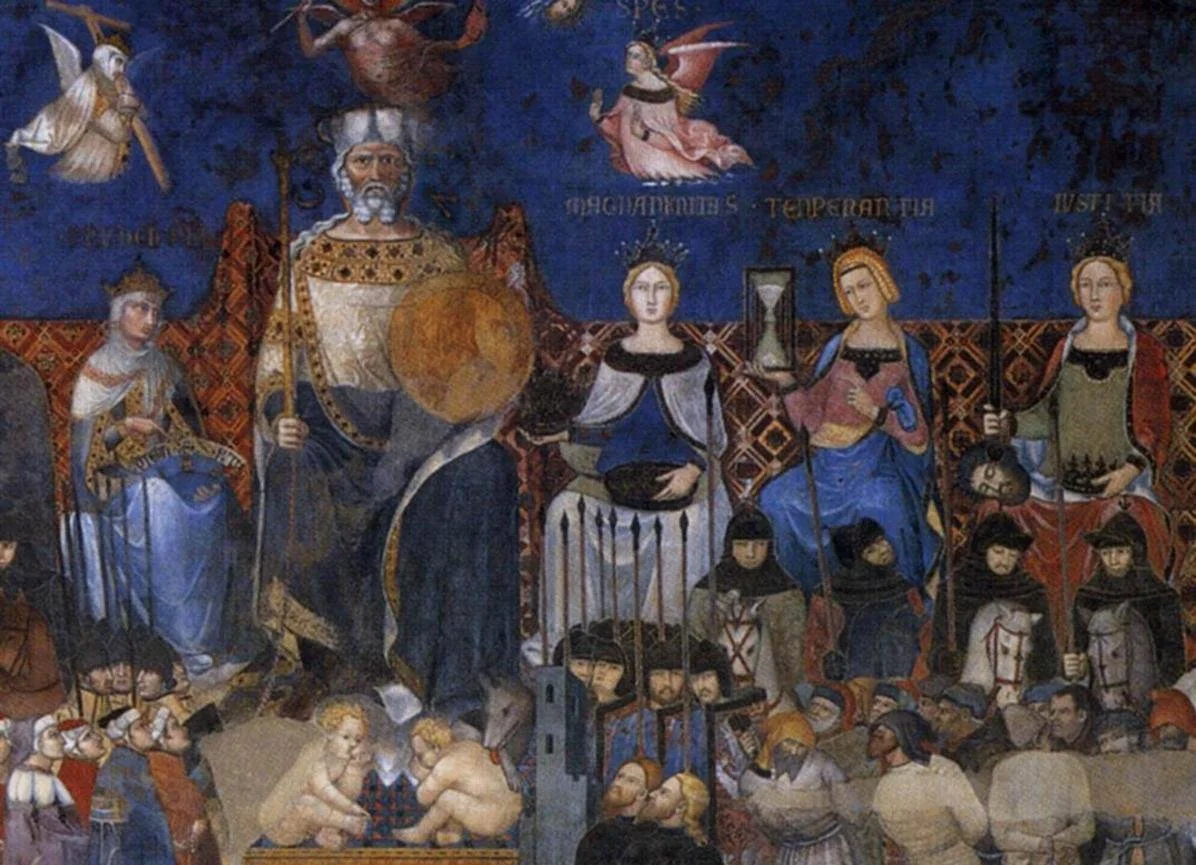
Ambrogio Lorenzetti, Allegory of Good Government (detail), 1338–39. Palazzo Pubblico, Siena.
From MAGA to Fidesz, Modi’s India to Xi’s China, political leaders and movements now treat the good life as a public matter: something to be taught, subsidised, protected and sometimes enforced. I call them good life states.
They are also less novel than they look. Aristotle said it first: the city exists not just for the sake of life, but for the sake of the good life. Seen against that long history, it is liberalism that looks unusual: a hard-won attempt to step back from authoritative answers to the question of how to live.
For each of the book’s five cases — China, Hungary, India, Israel, and the United States — I spend around two months in country, in long conversations with influential insiders and their critics. The book is written from encounters in offices, ministries, universities, religious centres and think tanks, where people are working out what their political ideals require in practice.
The aim is to describe these projects in terms their own advocates could recognise, then test them against the realities built on them. Each conversation turns on three questions:
When you think about the good life for your society, what does it look like?
Why is that vision worth defending?
What should the state do to advance it?
The book has two aims. The first is to understand how good life states cultivate their goods and give them institutional force, and why they appeal to so many people. The second is to ask how liberalism should answer them: how it can give people real reasons to love it without becoming a good life state itself.
Under contract with Allen Lane (Penguin) in the UK and Liveright (W. W. Norton) in North America.
HENRI BERGSON

The philosopher Henri Bergson (1859 - 1941) writing in his office. Photograph by DORNAC, extracted from the Larousse Archives, Paris.
I am also a specialist in the philosophy of Henri Bergson (1859–1941). In his day, Bergson was an academic star and a cultural sensation. Parisians called it Bergsonmania, and he even caused Broadway’s first traffic jam when New Yorkers rushed to hear him speak.
With wonderful colleagues, I have worked to introduce him to English-speaking readers through edited collections, original research, and, with Nils F. Schott, an English edition of his 1904–1905 Collège de France lectures, Freedom (Bloomsbury, 2024). If you’re curious, start with his 1920 Oxford lecture, “The Possible and the Real.”
My research has been supported by fellowships from Princeton University’s Center for Human Values, Cornell University’s School of Criticism and Theory, and Tsinghua University, among others.
PDFs of my journal articles and chapters are available on my Academia.edu page.